When brand owners and STEM course providers begin sourcing OEM educational toys, one of the first questions is straightforward: *what exactly can be customized?*
The answer matters because it shapes your product's market fit, brand identity, and compliance readiness — all before a single unit leaves the production line. Unlike consumer electronics where customization is mostly cosmetic, interactive educational toys involve layers of adaptation: physical appearance, audio and language programming, learning content, electronic modules, packaging formats, and market-specific testing.
This guide breaks down each customization layer available through a factory-direct OEM/ODM partner like YSGO, so you can scope your project accurately and communicate requirements clearly from the first inquiry. For a full overview of YSGO's customization capabilities, visit the OEM/ODM educational toy customization section.
Start With the Customization Depth
Before discussing colors, packaging, audio, or learning content, buyers should first define the customization depth of the project. Most OEM educational toy projects fall into three levels: standard platform customization, semi-custom development, and new ODM development.
A standard platform project usually keeps the existing product structure and electronic solution, then customizes visible and content-related elements such as logo, housing color, packaging, language, audio scripts, cards, and manuals. A semi-custom project may adjust function logic, play modes, learning content, cartridge structure, or accessory combinations. A new ODM project may involve new tooling, modified PCB design, new electronic modules, or a new product concept built around a buyer's curriculum or branded product line.
Defining this level early helps the factory evaluate tooling needs, sample cost, MOQ, development time, and testing requirements more accurately.
Logo and Brand Identity Customization
Brand placement is typically the first customization layer buyers define. In OEM educational toys, branding goes beyond a printed logo on the housing — it encompasses the full visual identity a child or educator encounters when unboxing the product.
What can be customized:
- Product housing: Logo placement via pad printing, silk screening, or mold engraving on shells and casings
- On-screen elements: Brand splash screens or startup animations for products with LCD/LED displays
- Audio branding: Custom startup sounds, branded voice prompts, or jingle integration
- Accessory branding: Logo application on learning cards, cartridges, stylus pens, and peripheral components
- Documentation: Branded instruction manuals, quick-start guides, and warranty cards
For products like Y-Pen Smart Learning Pens and Y-Card Learning Players, branding extends into the interactive experience itself — voice prompts can reference your brand name, and startup sequences can feature your identity.
What to prepare: Provide vector logo files (AI or EPS format), brand color codes (Pantone or CMYK), and guidelines for any audio branding you require.
Color Customization
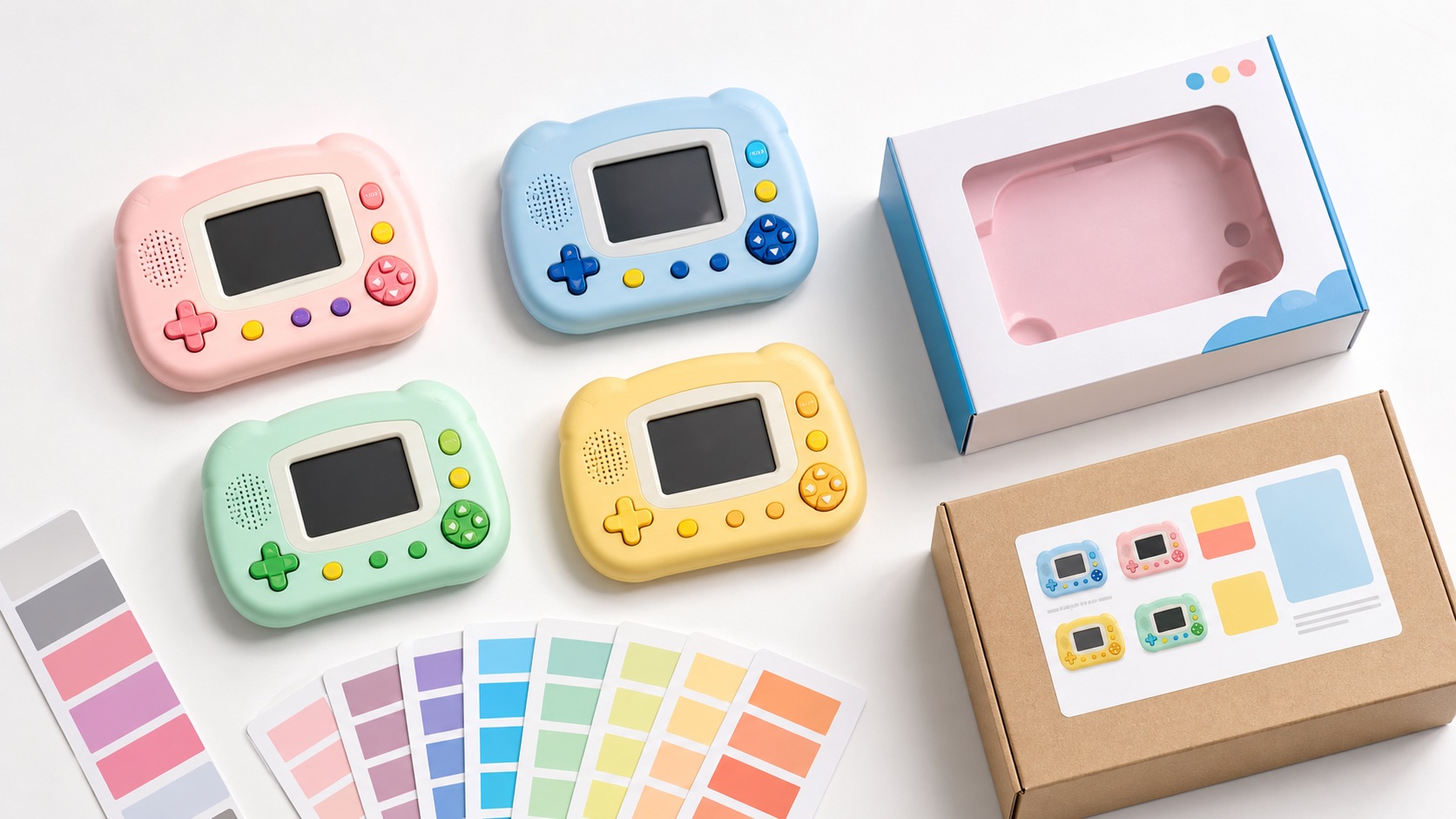
Color selection in educational toys affects both shelf appeal and brand consistency across your product catalog. OEM customization allows you to specify housing colors, button colors, accent details, and even internal component tinting where visible.
What can be customized:
- Housing shells: Full-body color matching to Pantone references or supplied samples
- Buttons and controls: Individual button colors, often contrasting with the housing for age-appropriate visual clarity
- Accent elements: Trim rings, speaker grilles, battery covers, and grip textures
- Surface finishes: Matte, gloss, soft-touch, or textured finishes depending on the material and mold design
- Multi-color schemes: Two-tone or multi-color injection molding for more complex visual designs
Color changes that only involve paint or surface coating are typically lower-cost adjustments. Changes requiring new mold inserts or multi-shot injection molding involve tooling considerations that should be discussed early in the project timeline.
What to prepare: Pantone color references, physical color samples if available, and notes on any finish preferences (matte vs. gloss, textured vs. smooth).
Packaging Customization: Retail, Gift, and Wholesale Formats
Packaging is not a single specification — it varies significantly depending on whether the product ships to retail shelves, arrives as a gift set, or moves through wholesale and distribution channels. OEM partners can often support retail, gift, and wholesale packaging formats for the same product platform, depending on packaging structure, order quantity, and channel requirements.
Retail packaging includes printed window boxes, blister packs, or display-ready cartons designed for shelf merchandising. These require print-ready artwork, barcode/UPC placement, and regulatory markings for the destination market.
Gift packaging may involve premium box materials, magnetic closures, foam inserts, ribbon details, or sleeve designs suited for direct-to-consumer gifting or institutional purchasing (e.g., school gift programs).
Wholesale/bulk packaging focuses on protection during transit — inner boxes, master cartons, divider inserts, and palletization specifications. Labeling for wholesale often follows different requirements than retail, including case-pack quantities and shipping marks.
What to prepare: Packaging artwork files, dieline specifications if available, barcode/SKU data, destination market language requirements for packaging copy, and any retailer-specific packaging compliance guidelines.
Language and Audio Customization
For educational toys entering global markets, language and audio customization is often the most impactful — and most complex — layer of OEM adaptation. Interactive products rely on spoken prompts, recorded vocabulary, songs, sound effects, and quiz feedback that must align with the target language, dialect, and educational curriculum.
What can be customized:
- Voice language: Full audio replacement in the target language, including pronunciation accuracy for educational vocabulary
- Multiple language modes: Some products support switchable language modes (e.g., English/Spanish, Mandarin/English) within a single unit
- Voice talent and tone: Selection of voice talent — age-appropriate, gender, accent, and speaking pace suitable for the target age group
- Sound effects and music: Replacement or addition of sound effects, background music, reward sounds, and interactive feedback tones
- Volume and audio quality: Speaker output tuning and audio bitrate adjustments for clarity in classroom or home environments
Products like Y-Card Learning Players and Y-Pen Smart Learning Pens are designed with audio customization as a core capability — their cartridge and card-based architectures make language swapping more modular than products with fixed firmware audio.
What to prepare: Target language list, script content or curriculum references, preferred voice talent specifications, and audio files if you are supplying your own recordings.
Learning Card and Cartridge Content Customization
For card-based and cartridge-based educational toys, the learning content itself is a customizable product layer. This is particularly relevant for brands and STEM course providers who want to align OEM products with their proprietary curriculum or educational methodology.
What can be customized:
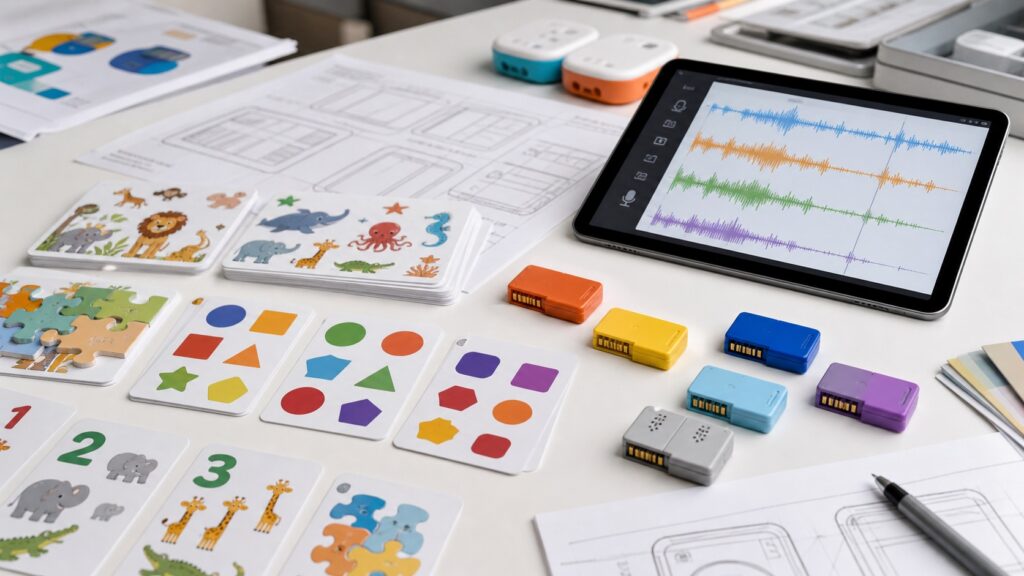
- Card content and design: Illustrations, subject topics, difficulty levels, and card sequencing for learning card sets
- Cartridge programming: Subject-specific cartridges (e.g., math, language, science, music) with custom question banks, answer logic, and feedback scripts
- Curriculum alignment: Content structured to match national or regional educational standards (e.g., Common Core, UK National Curriculum, local STEM frameworks)
- Difficulty progression: Graded content sets that scale from introductory to advanced, supporting multi-age or multi-grade deployment
- Quiz and interaction logic: Customized scoring systems, time-based challenges, hint mechanisms, and reward sequences
The STEM Logic Thinking Training Blocks product line, for example, uses a physical card-plus-block system where both the illustrated challenge cards and the block configurations can be adapted to different logic curricula.
What to prepare: Subject scope, target age group, curriculum references or educational standards, any proprietary content you want integrated, and approval workflows for educational review.
Function and Module Customization
Beyond appearance and content, OEM educational toys can be customized at the functional and electronic level. This is where ODM-level engineering becomes relevant — modifying what the product *does*, not just how it looks or sounds.
What can be customized:
- Input modules: Button layouts, touch-sensor zones, tilt/motion sensors, or microphone inputs
- Output modules: Speaker configurations, LED light patterns, screen types (LCD, e-ink), or vibration feedback
- Connectivity: Bluetooth, USB-C, or audio-jack interfaces for companion app integration or content updates
- Power and battery: Battery type (rechargeable vs. replaceable), capacity, charging method (USB vs. dock), and auto-sleep timers
- Play modes: Addition or removal of game modes, difficulty settings, multiplayer support, or AI-driven adaptive play
- Sensor integration: Light sensors for ambient adjustment, proximity sensors for auto-activation, or NFC readers for card detection
Function customization often depends on the base platform. Some modifications — like adding a play mode or changing LED patterns — can be achieved through firmware updates. Others — like changing sensor types or screen sizes — require hardware engineering and may affect tooling, BOM cost, and development timeline.
What to prepare: A functional requirements document describing desired play modes, interaction types, input/output expectations, and any integration requirements with your existing apps or platforms.
How Customization Affects Cost, MOQ, and Lead Time
Not every customization item has the same impact on cost or production planning. Logo printing, color matching, packaging artwork, and language replacement are usually easier to quote because they can often be handled on an existing product platform. Hardware changes, new molds, new sensors, rechargeable battery changes, or new learning interaction logic require a deeper engineering review.
For importers and distributors, this distinction matters because a lower-risk customization path can support faster product testing in the market. For educational toy brands and STEM course providers, a deeper customization path may be more suitable when the product needs to match a proprietary curriculum, branded learning system, or long-term SKU roadmap.
A practical inquiry should separate must-have requirements from nice-to-have requirements. This allows the factory to recommend a realistic version for sampling first, then plan additional upgrades for future production cycles.
Product-Line Development
Some buyers are not customizing a single SKU — they are building an entire branded product line. OEM/ODM partners with a broad platform base can support this by adapting multiple product types under a unified brand identity.
What this involves:
- Cross-product branding: Consistent visual identity, color scheme, and packaging design language across different product types (e.g., a learning pen, a card player, and a logic game sharing one brand look)
- Shared content ecosystem: Learning cards, cartridges, or digital content designed to work across multiple products in the line
- Age-range coverage: Products targeting different developmental stages (e.g., 2–4, 4–6, 6–8 years) within a single branded collection
- SKU planning: Coordinated MOQs, packaging variations (individual vs. bundle), and assortment packs for wholesale distribution
- Phased rollout: Launching with a core product and expanding the line in subsequent production cycles
YSGO's product portfolio — spanning Y-Card Learning Players, Y-Pen Smart Learning Pens, STEM Logic Thinking Training Blocks, and early learning devices — provides a platform base for building multi-product lines without starting each product from scratch.
What to prepare: Your product-line roadmap, target age segments, brand identity guidelines, and any platform preferences or constraints.
Sample Confirmation Before Mass Production
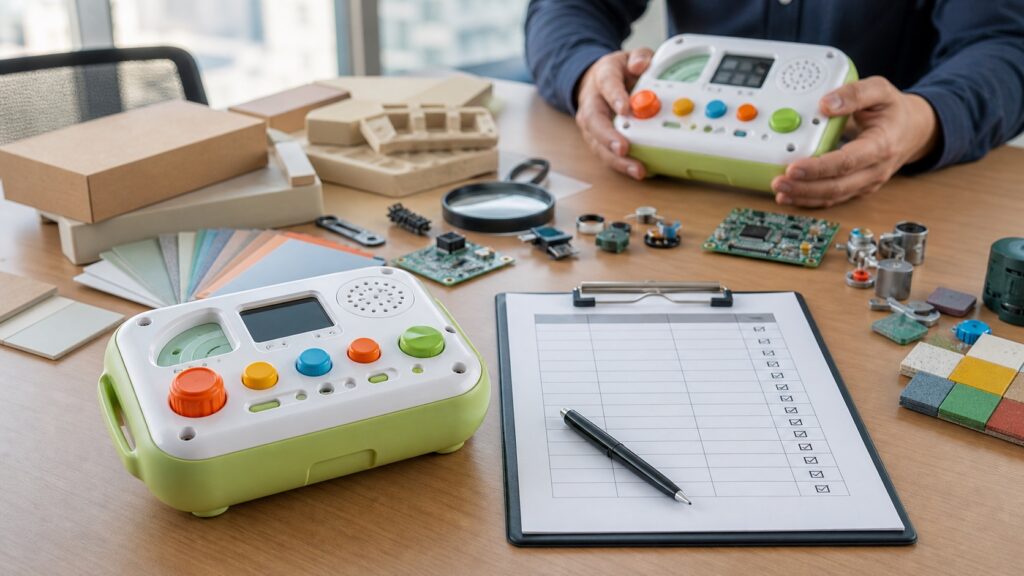
For customized OEM projects, sample confirmation is normally used before mass production to align the buyer and factory on appearance, function, content, packaging, and inspection references.
The typical sample process includes:
- Engineering samples (ES): First functional prototypes to verify electronic performance, structural fit, and basic interaction
- Design samples (DS): Units incorporating your custom colors, branding, and surface finishes for visual and tactile approval
- Pre-production samples (PPS): Near-final units produced on the actual production tooling, including final packaging, printed materials, and content programming
- Golden sample: The approved reference unit that sets the standard for mass production quality
Each stage includes a review and sign-off cycle. Adjustments identified at any stage are incorporated before advancing to the next.
What to prepare: A clear approval workflow on your side — who reviews, who signs off, and what turnaround time you can commit to. Delays in sample approval are one of the most common causes of production timeline slippage.
Change Control During Sampling and Production
Customization projects often change during sampling. A buyer may adjust a Pantone color, revise a voice prompt, reduce the number of cards, change the retail box size, or update warning labels after reviewing the first sample. These changes are normal, but they should be recorded clearly so that the final production version matches the approved specification.
For OEM educational toys, change control should include the product model, sample version, artwork version, audio file version, card content version, packaging version, and approved test requirements. Once the pre-production sample is confirmed, the approved sample and files should become the reference for mass production inspection.
This process helps reduce misunderstandings between the buyer, factory, packaging supplier, audio supplier, and assembly team, especially when the product includes multiple customized layers.
Target Market Testing and Compliance Requirements
Customization scope is not complete without addressing the compliance requirements of your destination market. Testing and certification needs vary by region and product type, and they should be defined before production — not after.
Key considerations:
- Regional standards: Products can be manufactured and tested according to project and market requirements, including EN71 (EU), ASTM F963 (US), IEC 62115 (electrical toys), and other applicable standards
- Chemical and material testing: 7P phthalate testing, HR4040 flammability testing, and restricted substance requirements as applicable
- Market access markings: CE (EU), UKCA (UK), and other conformity markings where applicable
- Age grading and labeling: Appropriate age recommendations, choking hazard warnings, and battery safety notices per regional regulations
- Documentation: Test reports, declarations of conformity, and technical files as required by importers or regulatory authorities
It is important to define your target markets and their specific requirements early in the project so that material selection, component sourcing, and product design can accommodate compliance needs from the outset. Retrofitting compliance into a finalized design is more costly and time-consuming than building it into the specification.
For more details on how YSGO supports market-specific testing and documentation, see quality and compliance support.
What to prepare: Target market list, any retailer-specific compliance requirements, and any existing test reports from previous product versions.
Factory Review Checklist Before Quotation
After receiving a customization inquiry, a factory-side review normally checks whether the requested changes affect appearance, content, electronics, tooling, packaging, testing, or shipment planning. This review is important because two projects that look similar on the surface may require very different development work behind the scenes.
For interactive educational toys, the review should cover the base product model, target age group, target market, learning goal, language version, audio script length, card or cartridge quantity, electronic function changes, battery requirements, packaging type, order quantity, and expected launch schedule. If the product will be used in schools, activity centers, or STEM courses, the review should also consider repeated-use durability, classroom activity flow, and teacher-friendly operation.
Providing these details at the beginning helps the factory return a more useful quotation instead of a general price range that still needs many follow-up questions.
How to Prepare Your Customization Inquiry
A well-prepared inquiry accelerates the quoting and development process. Before reaching out to an OEM partner, organize the following:
| Category | What to Include |
|---|---|
| Brand assets | Vector logos, brand color codes (Pantone/CMYK), brand guidelines |
| Product scope | Target product type(s), reference models or similar products, desired modifications |
| Content requirements | Target languages, curriculum references, subject areas, age groups |
| Functional requirements | Desired play modes, interaction types, connectivity, power source preferences |
| Packaging specifications | Format (retail/gift/wholesale), artwork files, barcode/SKU data, destination market language |
| Compliance requirements | Target markets, required certifications, retailer-specific standards |
| Volume and timeline | Estimated order quantities, target delivery dates, phased rollout plans |
| Budget parameters | Target FOB price range, tooling budget flexibility, sample budget |
The more detail you can provide upfront, the more accurate and actionable the initial quotation and project plan will be.
Download the OEM Customization Inquiry Checklist
Before sending your OEM/ODM inquiry, it is helpful to organize your customization requirements in one place. Download the OEM Customization Inquiry Checklist for Educational Toys to prepare your product scope, branding, language, learning content, function modules, packaging, compliance needs, quantity, timeline, and sample approval details.
A clearer inquiry helps the factory review feasibility faster and provide a more accurate quotation and development plan.
Download the OEM Customization Checklist
Frequently Asked Questions
What is the easiest way to start an OEM educational toy project?
The easiest path is to start from an existing product platform and customize the logo, color, packaging, language, audio, learning cards, or cartridge content. This allows the buyer to test the product concept with lower development risk before considering deeper function changes or new tooling.
Can one educational toy be customized for different sales channels?
Yes. The same base product can often be adapted for different channels through packaging, language, content, SKU combinations, and accessory sets. For example, a distributor may need retail-ready packaging and barcode labeling, while a school or STEM course provider may need classroom sets, teacher-friendly instructions, or course-aligned learning cards.
What files should I prepare for custom audio and learning content?
Prepare the target language, final scripts, pronunciation notes, subject structure, answer logic, card artwork, and any curriculum references. If the buyer supplies audio files, the factory should also receive clear file names, sequence numbers, and approval notes so the audio can be matched correctly with cards, cartridges, or product buttons.
Can customized educational toys be tested for my target market?
Products can be manufactured and tested according to project and market requirements, including EN71, ASTM F963, IEC 62115, 7P, HR4040, CE, UKCA, or other applicable requirements where relevant. The exact testing scope should be confirmed based on the product type, target market, age grade, materials, electronics, and importer or retailer requirements.
What is the typical lead time for a fully customized OEM educational toy?
Lead time depends on the scope of customization. Projects using an existing platform with branding, color, and content changes typically range from 45 to 90 days from sample approval to shipment. Projects involving new tooling, function changes, or extensive content development may require 90 to 150 days or more. Sample development adds an additional 2 to 6 weeks before production begins.
Can I customize only part of the product and keep other elements standard?
Yes. Many OEM projects involve partial customization — for example, applying custom branding and packaging to a standard product platform, or changing only the language and content while keeping the hardware identical. Partial customization typically results in lower development costs and shorter lead times.
What is the minimum order quantity for customized educational toys?
MOQs vary by product type and customization depth. Simple branding changes on existing products may start at lower volumes, while projects requiring new tooling or significant hardware modifications generally require higher MOQs to amortize development costs. Specific MOQ guidance is provided during the quotation stage based on your project scope.
Who supplies the educational content — the buyer or the factory?
Both models are common. Some buyers provide complete content packages (scripts, audio recordings, artwork, curriculum documents) for integration. Others provide a content outline and rely on the OEM partner's in-house content development capabilities. A hybrid approach — where the buyer supplies core content and the factory handles localization, audio recording, and card/cartridge formatting — is also typical.
How does sample approval work for customized products?
The sample process typically involves multiple stages: engineering samples for functional validation, design samples for visual and branding review, and pre-production samples for final sign-off. Each stage includes a review cycle where you provide feedback and approve or request revisions. For customized projects, written approval of the pre-production sample is normally treated as the key reference before mass production begins.
Start Your OEM Customization Project
Defining your customization scope clearly from the outset is the foundation of an efficient OEM project. Whether you are adapting a single product or building an entire branded line, the earlier you specify your branding, content, function, packaging, and compliance requirements, the smoother the development and production process will be.
To discuss your project scope and receive a customization feasibility assessment, contact YSGO with your product requirements and brand assets. The team can walk you through platform options, customization capabilities, and indicative timelines based on your specific project.
